
Low Carbon Chinatown: 100 climate actions
Overview
Title: Low Carbon Chinatown: 100 climate actions
Time Period: October-November 2025
Themes: sustainable food, climate action, arts, carbon footprints
Executive Summary
Low Carbon Chinatown brought together artists, scientists, and Hackney residents to explore sustainable food cultures through a low-carbon banquet. The Climate Evidence Unit (CEU) contributed evidence and quantification for 100 climate actions, helping participants understand their potential impact and sparking conversation on accessible climate action. The project demonstrated how arts-based interventions can catalyse climate engagement across diverse communities.
Context/Challenge
The Low Carbon Chinatown project was created by artist and designer, Ling Tan, and has been exhibited across the UK and Europe in a range of multimedia formats. The project blends “art, science, and technology” and explores “how cultural knowledge, collective climate action, and everyday practices can reshape food systems, inspire broader environmental engagement, and contribute to more sustainable futures”.
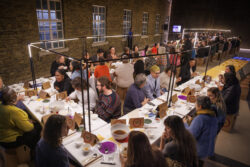
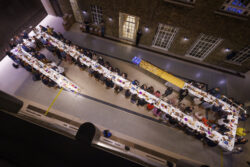
In autumn 2025, the project came to Hackney, London, with an exhibition (‘Harvesting Climate Action’) featuring 100 recyclable cardboard stools, each representing a different climate action alongside data visualisations, carbon footprint information, cooking videos and even produce. These stools were later repurposed as seating for the ‘Low Carbon Banquet For A Hundred’ in Hackney Town Hall in November 2025.
credit: photo by Nick Turpin
The banquet featured a range of guests, including members of the public, teachers, scientists, council staff, councillors and the Mayor of Hackney. Each guest was given one of the climate action stools on arrival, which corresponded to a place setting with further information about the climate action on a prompt card. The random allocation of the climate action stools ensured the banquet was a communal experience, seating participants from a range of backgrounds next to one another.
The banquet showcased low-carbon adaptations of authentic Chinese dishes, as well as provocations by guests around climate action as prompts to conversation. It concluded with voting on which of the climate actions they thought had the biggest impact, as well as those that they were already practising.
Objectives
The project was designed to encourage conversation around sustainable practices and collective climate action, prompted by food as a vehicle for bringing diverse people together.
The CEU worked with the project to:
- Contribute ideas for impactful climate actions to the collaborative list of 100;
- Quantify the 100 climate actions where possible, or otherwise provide scientific background on the possible impact of those actions;
- Provide a reflective quote on each action (or source quotes from elsewhere) around how impactful it is likely to be;
- Pose a provocation for banquet participants to generate further discussion.
Our Approach
The CEU began by trying to quantify the 100 climate actions through reviewing the available literature and data to provide robust evidence to underpin estimates of the impact of each action.
Estimates were provided based on the available data of the impact of these actions if one person completed it, if 100 did, and if the whole borough of Hackney undertook it. This was then compared to the equivalent number of return trips between London and Manchester by petrol car and numbers of low-carbon banquets. Where it wasn’t possible to quantify the climate action, background evidence, mostly from the scientific literature, was found to offer a sense of why the climate action was important.
The result of this was a list of 100 climate actions with associated evidence around impact, providing a useful resource for the banquet and beyond.
Key Findings
The challenge of quantifying the 100 actions highlighted the different motivations for pursuing climate actions. Though the CEU’s approach had been to bring a carbon footprinting perspective to indicate the ‘impact’ of the different actions, in reality, it was also important to acknowledge the non-carbon co-benefits of the actions.
For instance, actions such as increasing consumption of organic food can sometimes be ambiguous in terms of emissions reductions, whilst having clear benefits from ethical and wider environmental (for example biodiversity) perspectives.
Impact
credit: photo by Nick Turpin
The main impact of the work was its use within the banquet, where the data and evidence provided by the CEU acted as prompts for conversation between a diverse range of participants. The resources developed are also now available via the project website and could be used to start new climate conversations.
The project also involved a Low Carbon Children’s Banquet with a Hackney primary school. This has now become an annual event, and the 100 Climate Actions have been taken up as a curriculum resource.
This project provided an opportunity for the CEU to apply its expertise in carbon footprinting and evidence synthesis to an arts-led initiative.
Further Information
More information and resources relating to the project, including the 100 climate actions, are available here: https://lowcarbon.lingql.com/100-climate-actions
Thank-you to Dr Pete Walton (CEU) and Dr Andy Yuille (Lancaster University) for providing quotes to support some of the climate actions.
For more information about the CEU’s involvement in this project, please get in touch with Alice Garvey [email protected]