
Priestley Centre marks 10 years with prizes celebrating collaboration and impact
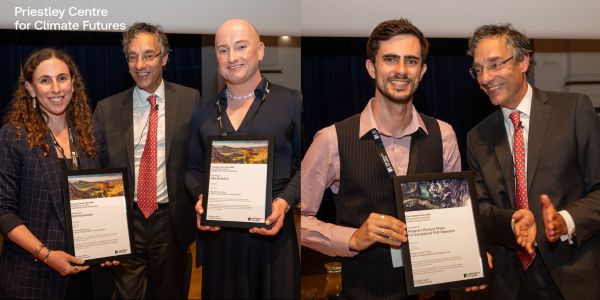
On 30 June, the Priestley Centre for Climate Futures marked its 10th anniversary by celebrating outstanding contributions to climate research and impact, awarding two prestigious prizes that reflect the Centre’s core values of collaboration, excellence and real-world change.
The awards underscored the breadth of work supported by the Priestley Centre over the past decade - from early-career research shaping global climate debates, to collaborative projects influencing policy and practice on the ground.
Celebrating impactful climate collaboration
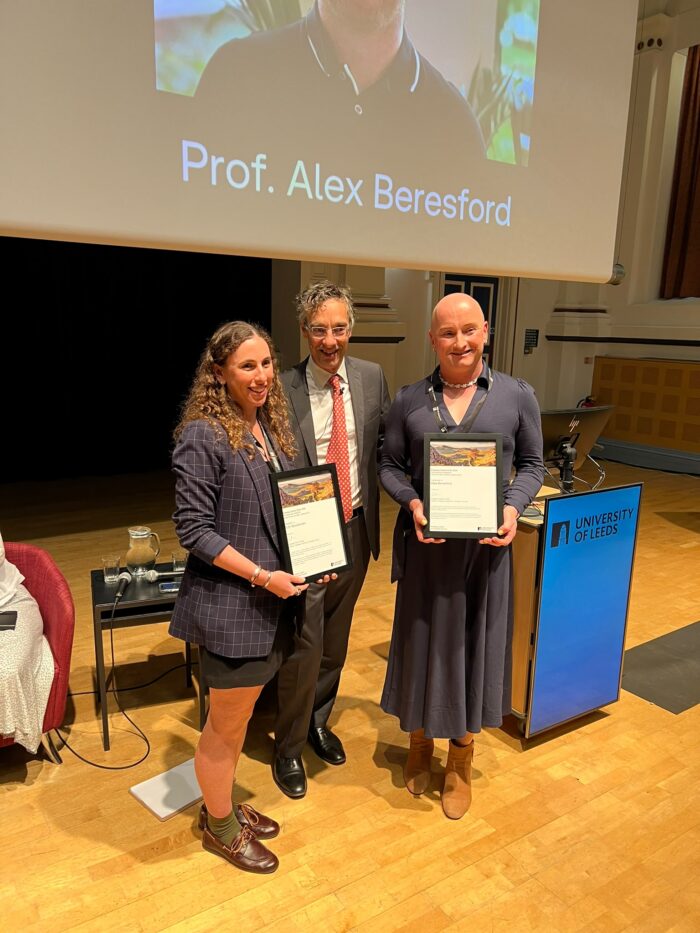
Dr Ruth Bookbinder [L] and Professor Alex Beresford [R] collect their prize from Professor Piers Forster, Priestley Centre Director.
South Africa’s shift from coal to renewable energy is a major socioeconomic transformation, supported by the COP26 Just Energy Transition Partnership (JETP). However, in the Mpumalanga coalbelt, the closure of mines and power stations threatens over 100,000 workers and their communities.
In partnership with the Sam Tambani Research Institute (SATRI) and the National Union of Mineworkers (NUM), Ruth and Alex have produced a unique dataset based on interviews with policymakers, civil society, and union leaders, alongside focus groups with workers. Their findings highlight widespread scepticism towards climate policy, driven by concerns that justice for working-class communities is being overlooked.
In response, they are advancing a bottom-up model of just transition co-designed with workers. This has led to a major report for the Hans Böckler Foundation, a participatory documentary (Voices from the Green Transition), and engagement with South Africa’s Presidential Climate Commission to shape policy. They are also producing climate education resources for unions.
Regarding the win, Alex said: “It has been a privilege to work directly with SATRI and the NUM on issues we all feel deeply passionate about. I am absolutely delighted to receive this award, which we dedicate to our partners and all those who have engaged with the project.”
Ruth added: “Working with and building the relationship with SATRI has made this a rewarding project that I love being a part of so it’s exciting for it to be recognised by the Priestley Centre as well”.
Funded by the Hans-Böckler Foundation, the research is part of a global project across 14 countries and has reached wide audiences through international workshops, policy forums including Chatham House, and national media such as BBC Radio 4.
Recognising emerging leaders in climate research
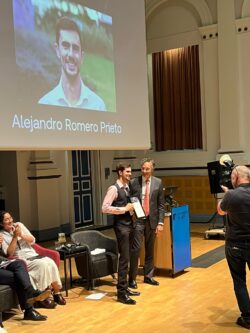
Alejandro Romero Prieto collects the prize on behalf of himself and Elliott, from Professor Piers Forster
The Piers Sellers PhD Prize for exceptional PhD research was jointly awarded to Alejandro Romero Prieto (Institute for Climate and Atmospheric Science/School of Earth Environment and Sustainability (SEES), University of Leeds) and Elliott Johnson (Sustainability Research Institute /SEES, University of Leeds), recognising exceptional doctoral research with global relevance.
Their work has made a significant contribution to international climate policy discussions through the development of a draft fossil fuel phase-out roadmap for Colombia. Produced in response to calls for more actionable climate strategies following COP30, the research offers one of the first comprehensive transition plans for a major fossil fuel exporting economy.
Combining energy systems modelling, economic analysis and just transition considerations, the roadmap demonstrates how Colombia could reduce fossil fuel demand by 90% by 2050. Importantly, it also shows that such a transition could bring substantial economic benefits, with projected savings of around USD 280 billion.
The work has already attracted global attention, featuring widely in international media and informing discussions at the first international conference on Transitioning Away from Fossil Fuels (TAFF), held in April this year in Colombia.

Elliott Johnson, joint winner of the Piers Sellers PhD Prize
Both Alejandro and Elliott played central roles in shaping the project, from developing the modelling
framework and integrating the latest data, to ensuring the research was accessible and relevant to Colombian stakeholders. Their commitment to open science, including a public GitHub repository, and bilingual communication has helped extend the reach and impact of the work.
Elliott said: “I would like to thank the Priestley Centre and the Executive Committee for selecting Alex and I as the winners of the 2026 Piers Sellers PhD Prize. We are very proud of the project, which brought together experts in energy systems, fossil fuel markets and just transition research, to produce a timely and impactful report.”
In the video below, Alejandro provides an overview of the project and a message of thanks:
A decade of climate impact
As the Priestley Centre reflects on its first decade, these prize winners exemplify the kind of research it seeks to foster: rigorous, collaborative, and focused on delivering tangible climate solutions.
From influencing national policy frameworks in South Africa to shaping global conversations on fossil fuel phase-out, the achievements recognised at the anniversary celebration highlight not only individual excellence, but the power of partnership in tackling the climate crisis.
Watch the prizes get awarded at our Celebrating 10 years of the Priestley Centre event on 30 June 2026.
Former PhD prize winners are: Benjamin Wallis (2024), Adele Dixon and Angus Naylor (2022), Oliver Grasham and Harriet Thew (2020), Tom Slater (2019), Kate Palmer and Jesus Vergara Temprado (2018), Ross Gillard (2017) and Kate Scott (2016). The first Priestley Centre prize for climate collaboration was awarded to the Yorkshire & Humber Climate Commission in 2024.