
Celebrating 10 years of the Priestley Centre
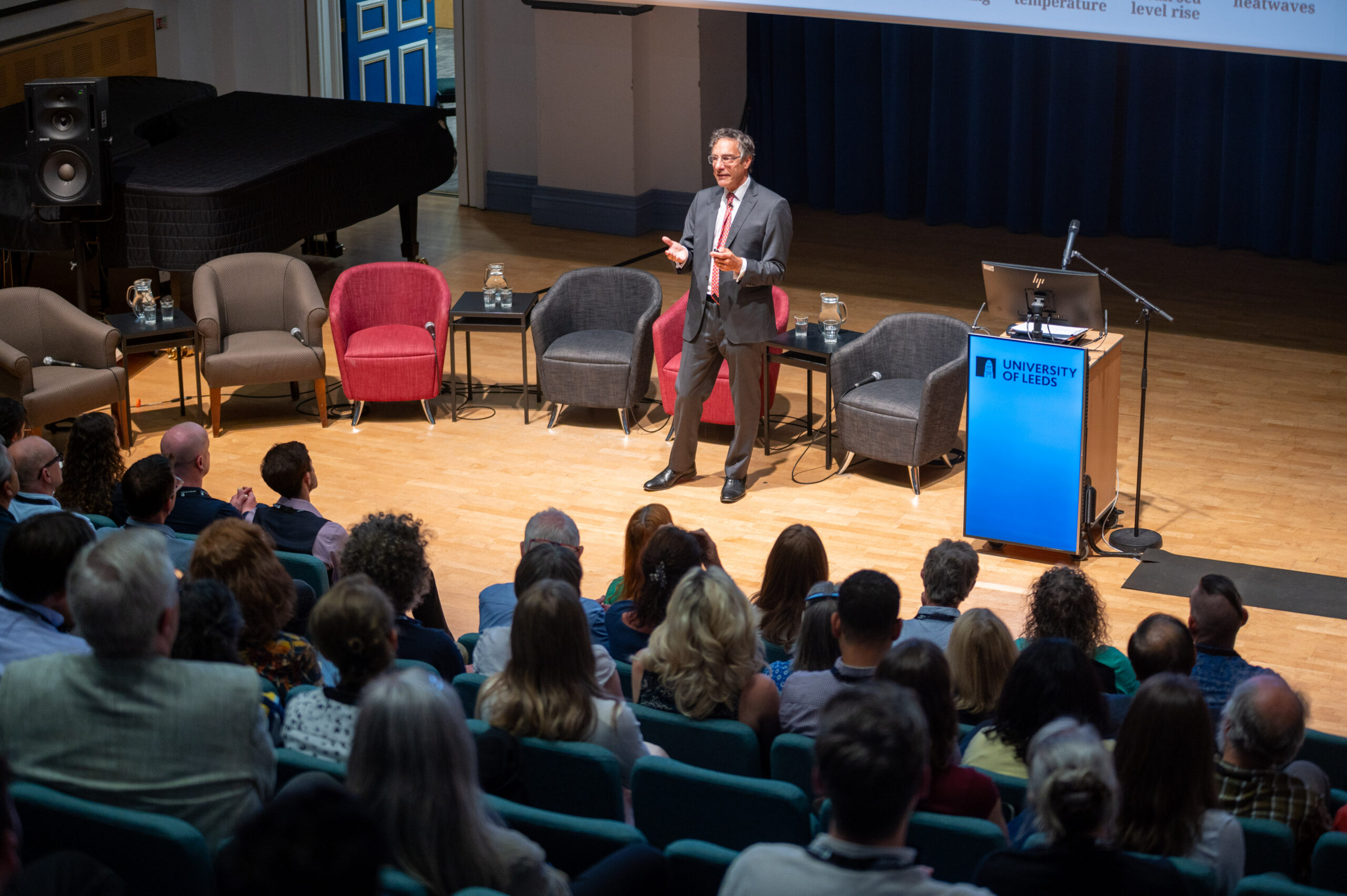
On 30 June, the Priestley Centre for Climate Futures marked its 10th anniversary, bringing together colleagues, partners, and friends from across the University of Leeds and beyond to celebrate a decade of climate research, collaboration, and impact.
The Priestley Centre was founded in June 2016, with an aim to bring together climate experts from across the University of Leeds to work collaboratively and deliver a variety of research and innovation projects.
Since then, it has grown from a team of 3 to a team of 20, with over 520 members of University of Leeds staff and students who are committed to climate research and to tackling climate change. The Centre has grown into a globally recognised hub for interdisciplinary climate expertise, it has informed national and global climate policy, supported businesses to take steps towards a net zero future, and supported the next generation of climate researchers.
Reflecting on a decade of climate leadership

University Vice-Chancellor, Professor Shearer West CBE
The celebration opened with a welcome from the University’s Vice-Chancellor, Professor Shearer West CBE, who reflected on the importance of sustained, collaborative action in addressing the climate crisis.
Professor West said:
When the Priestley Centre was founded ten years ago, it was built on a powerful and ambitious idea: that tackling climate change requires bringing together different disciplines, perspectives, and forms of expertise. Climate change is not only a scientific issue – it is economic, social, political, cultural, and ethical.
The University of Leeds is committed addressing climate change and embedding sustainability, a commitment reflected in the university strategy and the Climate Plan, which sits at the heart of supporting climate change mitigation and adaptation and contributing to a healthier, greener, and fairer place to live, work and study.
She continued of the Priestley Centre: “Its work exemplifies the kind of interdisciplinary, collaborative and impactful research that defines our university's approach.”
This was followed by a keynote from Professor Piers Forster CBE FRS, Director of the Priestley Centre,

Professor Piers Forster CBE FRS, Director of the Priestley Centre
who reflected on the Centre’s journey over the last ten years, and its role in positioning Leeds at the forefront of climate research and real-world impact.
He started his talk, ‘From Paris to Polycrisis: reframing climate action with pragmatic hope’ with memories of the Paris Agreement in 2015 and the optimistic excitement around it. He spoke about the IPCC (Intergovernmental Panel on Climate Change) special report on 1.5°, setting national net zero targets in 2019, the launch of the Indicators of Global Climate Change initiative, the Priestley Centre’s innovation programmes – including EarthScale and Climate Launchpad. Piers also spoke about what we can do with what we already have, and what we as a community can contribute, particularly around critical thinking, long-term effective governance, and radical collaborations.
Exploring pathways to positive climate futures
A panel discussion chaired by Priestley Chair, Interdisciplinary Climate Research, Professor Jason Lowe OBE, brought together voices from across academia, policy, industry, youth, and the NGO sector to explore how climate solutions emerge across different sectors.
 Panellists included:
- Piers Forster CBE FRS, Director of the Priestley Centre for Climate Futures and Member of the Climate Change Committee
- Libby Peake, Senior Fellow, and Head of Resource Policy at Green Alliance
- Pim Sullivan-Tailyour, Director of the UK Youth Climate Coalition
- David Wilkinson, Climate Lead for the Supervisory Risk Specialists Directorate of the Bank of England
- Chris Stark CBE, Head of UK’s Mission for Clean Power, UK Department for Energy Security and Net Zero
The panellists discussed practical pathways for delivering meaningful and positive climate action, highlighting the importance of working across disciplines and sectors to tackle shared challenges.
Creativity and climate: a collaborative showcase
Following the talks, guests explored an exhibition of creative, interdisciplinary work.
A sound installation curated by Dr Scott McLaughlin transformed the School of Music spaces, combining field recordings from Gair Wood (the University of Leeds' woodland site) with new compositions by students and researchers. The installation invited audiences to reflect on sound, place, and climate, while Dunwich - an audio-visual work by Professor Martin Iddon - offered a powerful meditation on climate loss and memory.
Collaboration was central throughout. Student composers worked with environmental researchers to create new pieces inspired by climate data and landscapes, demonstrating how research can inspire new forms of artistic expression.
Illustrator James McKay presented Dreams of a Low Carbon Future, a visionary project imagining Leeds as a zero-carbon city, while a series of climate poems curated by Matt Howard, developed through collaboration between poets and climate researchers, highlighted the role of the arts in communicating climate challenges.
Recognising excellence in climate research
The event also celebrated outstanding contributions to climate research.
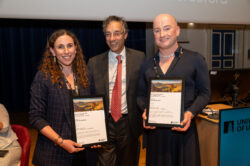
Professor Alex Beresford and Dr Ruth Bookbinder receive The Priestley Centre Prize for Collaboration
The Priestley Centre Prize for impactful research-led collaboration was jointly awarded to Professor Alex Beresford and Dr Ruth Bookbinder from the School of Politics and International Studies, for their work on just energy transitions in South Africa, helping ensure the voices of workers and communities are embedded in national climate policy.
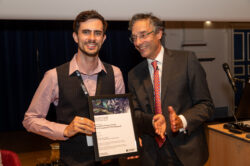
Alejandro Romero Prieto receives The Piers Sellers Prize for exceptional PhD research
The Piers Sellers Prize for exceptional PhD research was jointly awarded to Alejandro Romero Prieto and Elliott Johnson from the School of Earth, Environment and Sustainability, for their development of a science-based draft fossil fuel phase-out roadmap for Colombia, demonstrating how ambitious climate goals can be translated into actionable strategies.
Find out more about the prize winners here
Looking ahead
As the Priestley Centre enters its second decade, the celebration highlighted not only how far it has come, but the vital role it will continue to play in supporting interdisciplinary research, building partnerships, and driving meaningful climate action.
As Professor Piers Forster stated in his keynote:
If we do share effectively and really collaborate, we have the power to change the world together.
Watch the recording of the core programme here:
Event photo gallery