
International report reveals atmospheric impact of Hunga eruption
An international assessment report was released today, to provide definitive statements on the atmospheric impacts from a huge volcanic eruption in 2022.
The assessment was unprecedented, for a specific geophysical event, and involved more than 100 scientists from around the world, including four academics and Priestley members from the University of Leeds.
The Hunga volcano in the tropical Pacific erupted in January 2022, sending a plume of vaporised seawater deep into the stratosphere in an explosion that equalled the size of Krakatoa’s in 1883.
Based entirely on peer-reviewed research, the report brings together monitoring information from satellite measurements, field campaigns and ground-based observatories, to document the eruption’s far-reaching effects on the ozone layer and climate.
The Hunga assessment report’s main findings include:
- The eruption increased global stratospheric water vapour by about 10 percent, much of which remains in the atmosphere in 2025.
- Very large eruptions usually cause a stratospheric warming effect, but Hunga did the opposite, coolin the stratosphere, the layer of air ~10km above the ground.
- While Hunga did affect stratospheric ozone in the Southern Hemisphere, its effects on the Antarctic ozone hole and surface climate were minor.
Dr Yunqian Zhu, senior research scientist at the University of Colorado, Boulder and overall lead author for the report said:
The Hunga eruption was unlike anything our satellites have observed before. We have seen how water-rich volcanic eruptions can affect the stratosphere and how essential global cooperation is in monitoring and understanding such rare events.
Dr Graham Mann (University of Leeds) co-led with Dr Zhu the co-ordination of the report, added:
The reason for the report is large volcanic eruptions can have substantial impacts on climate and the ozone layer, the 1991 Pinatubo eruption for example causing a two-year global cooling effect, of a quarter to half a degree Celsius.
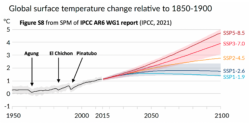
Figure 1: The largest historical major volcanic eruptions cause surface cooling of 0.2-0.5oC for 2-3 years after an eruption. These strong but short-lived natural radiative forcings are included within historical integrations for CMIP climate model intercomparisons, e.g. Aubry et al. (2025).
Dr Mann is a lecturer in atmospheric science at the School of Earth and Environment, and was researching Pinatubo’s impacts with colleague Dr Sandip Dhomse for the UK National Centre for Atmospheric Science when Hunga erupted.
Dr Mann said: “Although Hunga’s surface climate impacts were only minor, the eruption caused a strong cooling of the stratosphere, and a future eruption more similar to Pinatubo would be highly relevant for the 1.5oC Paris climate target. The Hunga report is an amazing community effort, and brings together the exciting science on the eruption’s impacts for a definitive assessment for how this unusual water-rich eruption perturbed the stratosphere.”
In addition to Dr Mann and Dr Dhomse, two other Leeds academics also contributed to the report, Professor Martyn Chipperfield, within the School of Earth and Environment, and Professor Amanda Maycock within the University’s Priestley Centre for Climate Futures.
Professor Maycock was a lead author of the Future Climate projections chapter of the 2021 IPCC climate assessment report (Lee, Marotzke et al., 2021), and was review editor for the Hunga assessment report climate impacts chapter (Stenchikov, Schoeberl et al., 2025).
Prof. Maycock said:
The Report shows that although water vapour is a greenhouse gas, Hunga had a net cooling effect overall”, explained Professor Maycock, “and did not cause the record global warmth observed in 2023 and 2024. This is an important finding as understanding what caused the recent surge in global warming is a priority for the climate science community.
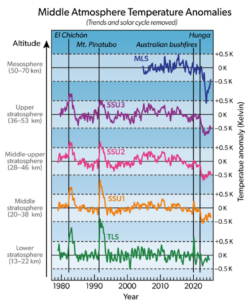
Figure 2: Multi-decadal record of air temperature in the stratosphere from the SSU sounder shows the warming anomalies after 1982 El Chichon and 1991 Pinatubo, an opposite-sign cooling effect caused by volcanogenic water vapour emitted from the 2022 Hunga eruption.
(Hunga report Figure ES-3, from Randel et al., 2024).
Dr Mann added: “The key metric for volcano-climate impacts is the amount of sulphur an eruption releases into the stratosphere, this determining how much sunlight the subsequent layer of volcanic sulphate aerosol reflects back out to space.”
“The Hunga volcano actually released a similar amount of sulphur to Pinatubo, but the shallow underwater setting meant 95 percent of sulphur emitted from the volcano was returned to the earth’s surface (Wu et al., 2025; Carn, Schmidt et al., 2025). The highly abundant water vapour from the seawater made the eruption more explosive, and meant both sulphur and water vapour were released deep into the stratosphere.”
For the water vapour surface warming effect, Dr Mann commented, “Ironically, it is because Hunga emitted the water vapour so deep into the stratosphere that surface climate impacts were only small. Had this huge amount of water vapour been emitted near the tropopause, there would have been a larger surface warming effect, adding to the 2023-24 global warmth (see Wang and Huang, 2024).”
Dr Dhomse and Professor Chipperfield have contributed to UNEP/WMO ozone assessment reports for over 20 years, and also contribute to the UK National Centre for Earth Observation.
Dr Dhomse commented:
Hunga’s volcanic water vapour emission also means the memory of the eruption will remain for much longer than a typical sulphur-rich eruption. The extra stratospheric water vapour will continue to influence both stratospheric chemistry and dynamics for several more years, within the slow circulation of air in the middle atmosphere.
Professor Chipperfield added:
From running models, we are able to isolate Hunga’s impacts on the ozone layer, distinguish from year-to-year variability and from human-caused impacts. Our modelling work feeds into international assessments, which are a key part of ensuring that the Montreal Protocol is on track to secure the ozone layer’s recovery.

Figure 3: Satellite measurements from the Aura-MLS instrument show Arctic stratospheric water vapour was substantially enhanced in the 2023/24 and 2024/25 winters, the arrival of the Hunga plume occurring in January 2023.
The schedule for the report’s publication was set specifically to feed into the 2026 WMO/UNEP Scientific Assessment of Ozone Depletion report, and the two phases of peer review for each chapter’s first and second draft were completed in autumn 2024 and spring 2025.
With the 5-10 year residence time of the Hunga excess water vapour, the science is continuing, to understand Hunga’s impacts on the stratosphere. One project on the eruption’s effects is a University of Leeds PhD studentship focused to quantifying polar ozone impacts. The project is a CASE studentship with the UK Met Office, and co-supervised by Mann, Chipperfield and Dhomse.
Aligned to the Leeds MOAP (Met Office Academic Partnership) the PhD project is analysing global model simulations of the Hunga stratospheric water vapour to assess the extent to which the extra water vapour may have led to a greater occurrence of polar stratospheric clouds.
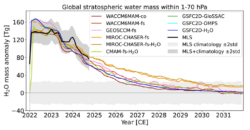
Figure 4: Satellite measurements (thick black line, and shading) are monitoring the progression of the Hunga-excess water vapour, and model projections (Zhuo et al., 2025) indicate another two to five years before the Hunga-excess water vapour is removed from the stratosphere.
University of Leeds PhD student Saffron Heddell explained:
What is clear from the MLS satellite measurements (e.g. Figure 4) is that although we are now almost 4 years on from the eruption, around half of the 150Tg of water vapour from Hunga is still circulating within the stratosphere.
The first phase of the Leeds Hunga ozone layer impacts PhD has focused to the Antarctic stratosphere, where the model finds the extra polar stratospheric clouds from the eruption’s excess water vapour caused a modest ~7% increase in the ozone hole area in 2023.

Figure 5: Previous large eruptions have impacted polar ozone mainly via chemistry on volcanic aerosol (upper diagram), whilst Hunga’s impacts have been via extra polar stratospheric clouds.
(Schematic diagram from Ms Saffron Heddell, University of Leeds).
Ms Heddell explained: "The extra stratospheric water vapour means polar stratospheric clouds (PSCs) form at slightly less cold temperatures, so earlier. There is evidence of this in the second Antarctic winter (2023) after the eruption leading to a modest increase to ozone depletion. The next phase of the research is to analyse PSC impacts during the recent 2024/25 Arctic winter, which was particularly cold and had ~1-2 ppmv extra stratospheric water vapour.”
Impacts from previous eruptions have tended to stem from the sulfate aerosol (see Figure 5a).
What has set Hunga apart is its polar ozone impacts appear to be related to the extra polar stratospheric clouds that formed as a result of the extra water vapour.
Dr. Mann added, “The Hunga eruption will provide a lasting case study to test the reliability of our models for a different type of volcanic perturbation. A key aspect of the modelling for the report is predicting the longevity of the Hunga water vapour. The case provides a test for how well our models represent transport and other processes in the upper stratosphere and mesosphere, within the so-called “deep branch” of the stratospheric circulation.”
Further information
- The “Hunga Volcanic Eruption Atmospheric Impacts” report is published 18th Dec 2025 by the World Climate Research Programme (WCRP), within WCRP activity “Atmospheric Processes and their Role in Climate” (APARC), based at Forschungzentrum Juelich (FZJ) in Germany (https://www.fz-juelich.de/en ). The PDF for the full Hunga report can be downloaded via Open Access PDF at https://doi.org/10.34734/FZJ-2025-05237
(see Hunga Highlights and Executive Summary sections for accessible summary info.) - Launched in February 2023, the Hunga assessment brought together 159 scientists from 21 countries, coordinated by Dr Yunqian Zhu (University of Colorado CIRES, USA), Dr William Randel (National Center for Atmospheric Research, USA), Dr Graham Mann (University of Leeds, U.K.), and Dr Paul A. Newman (University of Maryland, USA).
- For more information on the Hunga assessment report please contact WCRP science communications manager Carlos Montoya on [email protected] .
- To arrange interviews with Dr Mann, Dr Dhomse, Prof. Maycock or Prof. Chipperfield please contact the University of Leeds press office on [email protected]
- The National Centre for Atmospheric Science (https://ncas.ac.uk ) and National Centre for Earth Observation (https://www.nceo.ac.uk ) are distributed research centres, and funded by the Natural Environment Research Council, affiliated scientists based across multiple Universities in the UK.
- Satellite monitoring instruments developed by NASA, European Space Agency and the Japanese Space Exploration Agency provided data for the report, alongside ground remote sensing networks and field campaigns at Reunion Island and Sao Paulo, Brazil.
References
Aubry, T., M. Toohey, S. Khanal, M. Mei Chim, M. Verkerk, B. Johnson et al. (2025)
Stratospheric aerosol forcing for CMIP7 (part 1): Optical properties for pre-industrial, historical, and scenario simulations (version 2.2.1), https://doi.org/10.5194/egusphere-2025-4990 .
Carn, S., A. Schmidt et al. (2025): Volcanological context of the 2022 Hunga eruption. In APARC, 2025: The Hunga Eruption Atmospheric Impacts Report [Yunqian Zhu, Graham Mann, Paul A. Newman, William Randel (Eds.)]. APARC Report No. 11, WCRP Report No. 10/2025, available at: https://doi.org/10.34734/FZJ-2025-05238 .
Chipperfield, M. P., M. L. Santee et al. (2022): Chapter 4: “Polar stratospheric ozone: Past, present and future”, in Scientific Assessment of Ozone Depletion 2022, WMO Ozone research and Monitoring/Global Atmospheric Watch report no. 278, available at:
https://csl.noaa.gov/assessments/ozone/2022/downloads/Chapter4_2022OzoneAssessment.pdf .
IPCC (2021): Summary for Policymakers. In: Climate Change 2021: The Physical Science Basis.
Contribution of Working Group I to the Sixth Assessment Report of the Intergovernmental Panel on Climate Change [Masson-Delmotte et al. (eds.)]. Cambridge University Press. pp. 3−32, https://doi.org/10.1017/9781009157896.001 .
Khaykin, S., A. Bourassa et al. (2025): Atmospheric transport and evolution of Hunga water vapour and aerosols. In APARC, 2025: The Hunga Eruption Atmospheric Impacts Report [Yunqian Zhu, Graham Mann, Paul A. Newman, William Randel (Eds.)]. APARC Report No. 11, WCRP Report No. 10/2025, available at https://doi.org/10.34734/FZJ-2025-05240 .
Lee, Y.-H., J. Marotzke et al. (2021): Future Global Climate: Scenario-Based Projections and Near-Term Information. In Climate Change 2021: The Physical Science Basis. Contribution of Working Group I to the Sixth Assessment Report of the Intergovernmental Panel on Climate Change [Masson-Delmotte, V. et al., (eds.)]. Cambridge University Press, pp. 553–672, https://doi.org/10.1017/9781009157896.006 .
Østerstrøm, F. F., M. L. Santee et al. (2025): Effects of the Hunga eruption on stratospheric ozone and related trace gases. In APARC, 2025: The Hunga Eruption Atmospheric Impacts Report [Yunqian Zhu, Graham Mann, Paul A. Newman, William Randel (Eds.)]. APARC Report No. 11, WCRP Report No. 10/2025, available at https://doi.org/10.34734/FZJ-2025-05242 .
Randel, W. J., Wang, X., Starr, J., Garcia, R. R. and Kinnison, D. (2024): Long‐term temperature impacts of the Hunga volcanic eruption in the stratosphere and above, Geophys. Res. Lett., 51,e2024GL111500. https://doi.org/10.1029/2024GL111500
Stenchikov, G., M. R. Schoeberl et al. (2025): Radiative forcing and climate impacts caused by the 2022 Hunga volcano eruption. In APARC, 2025: The Hunga Eruption Atmospheric Impacts Report [Yunqian Zhu, Graham Mann, Paul A. Newman, William Randel (Eds.)]. APARC Report No. 11, WCRP Report No. 10/2025, available at https://doi.org/10.34734/FZJ-2025-05244 .
Wang, X., L. Coy et al. (2025): Hunga effects on stratospheric temperatures and circulation. In APARC, 2025: The Hunga Eruption Atmospheric Impacts Report [Yunqian Zhu, Graham Mann, Paul A. Newman, William Randel (Eds.)]. APARC Report No. 11, WCRP Report No. 10/2025, available at https://doi.org/10.34734/FZJ-2025-05241 .
Wang, Y. and Y. Huang (2024): Compensating atmospheric adjustments reduce the volcanic forcing from Hunga stratospheric water vapor enhancement, Science Advances, 10, eadl2842,
https://doi.org/10.1126/sciadv.adl2842 .
Wu, J., S. J. Cronin, M. Brenna, S.-H. Park, A. Pontesilli et al. (2025): Low sulfur emissions from 2022 Hunga eruption due to seawater–magma interactions, Nature Geoscience, 18, 518-524
https://doi.org/10.1038/s41561-025-01691-7 .
Zhuo, Z. X. Wang, Y. Zhu, W. Yu, E. M. Bednarz, E. Fleming, P. Colarco, S. Watanabe et al. (2025):
Comparing multi-model ensemble simulations with observations and decadal projections of upper atmospheric variations following the Hunga eruption, Atmos. Chem. Phys., 25, 13161–13176, https://doi.org/10.5194/acp-25-13161-2025 .