
Do United Nations climate conferences drive meaningful climate action?

A blog written by COP31 delegate Jyoti Narsude.
COP as a governance mechanism
Despite more than 30 years of international climate negotiations, global greenhouse gas emissions continue to rise. Each year, governments meet under the framework to negotiate climate goals, mobilise finance, and coordinate global action. Supporters see these conferences as essential for collective progress, while critics argue they generate ambitious promises with limited implementation. This raises an important question: do UN climate conferences drive meaningful climate action, or are they primarily forums for diplomatic consensus?
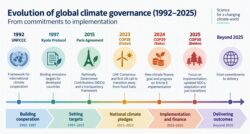
While their impact is often judged by the agreements they produce, COP conferences play a broader role in shaping global climate governance. From the Kyoto protocol (1997) to the Paris agreement (2015), they have created frameworks that influence national policies, investment decisions, and international cooperation. Their significance lies less in enforcing action directly and more in setting direction, building accountability, and encouraging countries to strengthen climate action over time
From commitment to implementation: COP28, COP29 and COP30
Looking across COP28, COP29, and COP30, the focus of global climate governance appears to have shifted from setting ambitious targets to ensuring their implementation. COP28's UAE Consensus marked the first explicit call within the UN climate regime to transition away from fossil fuels while accelerating renewable energy deployment and energy efficiency (UNFCCC, 2023; WRI, 2024). COP29 placed climate finance at the centre of negotiations, agreeing a new goal of at least US$300 billion annually by 2035 and advancing implementation through the finalisation of key elements of the Paris Agreement's Article 6 carbon-market framework (UNFCCC, 2024; UNCTAD, 2024).
COP30 continued this emphasis on delivery through updated nationally determined contributions (NDCs), adaptation measures, just-transition strategies, and the Baku-to-Belém roadmap, highlighting climate finance as a critical test of the international climate regime's credibility (COP30 Presidency, 2025; Falkner, 2016). Together, these developments suggest that the central challenge is no longer defining climate ambition but translating commitments into action.
Why do commitments not always translate into action?
Despite increasingly ambitious international climate agreements, implementation remains the greatest challenge. Global greenhouse gas emissions reached record levels in 2023, and current policies still leave the world off track for the Paris Agreement's 1.5°C goal (UNEP Emissions Gap Report 2024). Climate finance also remains insufficient: although COP29 agreed a new target of at least US$300 billion annually by 2035 for developing countries, this falls well short of estimated global needs for mitigation, adaptation and resilience (UNCTAD, Climate Policy Initiative). Implementation is further constrained by domestic political and economic pressures, including fiscal constraints, energy-security concerns and changing government priorities (Climate Action). Finally, because COP decisions generally lack strong enforcement mechanisms, progress relies largely on transparency, peer pressure and political accountability rather than formal sanctions (Global Climate Governance in 2025). Together, these challenges suggest that the key problem in climate governance is no longer a lack of commitments, but a lack of delivery.
In conclusion, COP conferences are neither mere diplomatic talking shops nor a complete solution to the climate crisis. Their greatest value lies in creating the norms, institutions and financial frameworks that enable collective climate action. From the Kyoto Protocol to the Paris Agreement, and more recently the focus on finance and implementation at COP28, COP29 and COP30, the climate regime has continually adapted to changing realities. Ultimately, however, the success of COP is judged not by the agreements reached but by what happens afterwards. The credibility of the process will depend on whether commitments translate into tangible outcomes: lower emissions, faster energy transitions, greater climate resilience and improved access to finance for vulnerable countries. In short, the future of climate governance will be determined less by what is promised at COP and more by what is implemented afterwards.
References
Bodansky, D. (2016). The Paris Climate Change Agreement: A New Hope? American Journal of International Law, 110(2), 288-319.
COP30 Presidency. (2025). Baku-to-Belém Roadmap and COP30 Priorities
Dimitrov, R. S. (2016). The Paris Agreement on Climate Change: Behind Closed Doors. Global Environmental Politics, 16(3), 1-11.
Falkner, R. (2016). The Paris Agreement and the New Logic of International Climate Politics. International Affairs, 92(5), 1107-1125.
UNCTAD. (2024). Countries Agree on US$300 Billion by 2035 New Climate Finance Goal: What Next?
UNEP. (2024). Emissions Gap Report 2024: No More Hot Air... Please! With a Massive Gap Between Rhetoric and Reality, Countries Draft New Climate Commitments. United Nations Environment Programme.
UNFCCC. (2023). Outcome of the First Global Stocktake and the UAE Consensus, COP28.
UNFCCC. (2024). COP29 Outcomes: New Collective Quantified Goal on Climate Finance and Article 6 Decisions.
World Resources Institute. (2024). COP28 Outcomes and Next Steps for Global Climate Action.