
Bridging the Gap: Representing Farmers and Marginalised Voices at COP30
How can farmer-led research drive just rural transitions?
As world leaders gather in Belém for COP30, the question of how to transform food systems fairly and sustainably has never felt more urgent. Food production both drives and suffers from climate change - yet the people most affected by its impacts often have the least voice in shaping global solutions. Researchers from the University of Leeds are helping change that narrative through work showcased at this year’s COP.
From research to real-world impact
The University’s Global Food and Environment Institute (GFEI) provides a global hub for food systems innovation at Leeds, uniting researchers from across disciplines to deliver practical solutions for a healthy, equitable, and sustainable future.
Over the past decade, GFEI researchers have been exploring how food systems transformation, climate change, and inequalities intersect in rural communities across Africa, Asia, and Latin America. Projects such as GCRF-AFRICAP, FoSTA-Health and ClimBeR examine how market-oriented agricultural reforms and climate extremes affect livelihoods, health, and equity.

Farmers in Tanzania share their experiences of climate change and agriculture during a participatory visioning workshop
LONGFALLOWS and the CCCEP Legacy project built partnerships with Tanzanian communities to co-design forest and farm management practices that balance people’s needs with ecosystem restoration.
A common thread runs through these initiatives: participation matters. When farmers and local organisations are part of designing research and policy, the resulting innovations are more relevant, more inclusive, and more sustainable.
Introducing Voices4JRT#
This year marks the launch of Voices for a Just Rural Transition (Voices4JRT) - a four-year collaboration between the University of Leeds and Clim-Eat and funded through the UK Foreign, Commonwealth & Development Office’s Just Rural Transition Support Programme. The project works with civil-society and farmer organisations in pilot focal countries of Brazil, Indonesia, and Tanzania to bring diverse rural voices into national and global debates on agricultural policy reform and subsidy repurposing.
Using creative, participatory methods such as photovoice and participatory video, Voices4JRT will capture farmers’ visions for fairer, more sustainable food futures and help them communicate these within global fora and directly to policymakers. The goal is not only to influence policies, but to create lasting communities of practice that link grassroots experience with global decision-making spaces like COP.

By engaging farmers of all ages and genders, the Voices4JRT project ensures that a wide range of lived experiences and visions inform the journey towards fair and sustainable food-system transformation.
“Voices4JRT will be a megaphone for the marginalised, ensuring smallholder farmers – who produce around a third of our food – can participate in shaping more resilient food systems,” said Dhanush Dinesh, founder of Clim-Eat. “A more just, equitable and sustainable food future starts here.”
At the heart of this work is the idea of justice - recognising that transforming food systems isn’t only about productivity or technology, but about fairness, voice, and power: who benefits, who bears the costs, and who gets to shape the future.
Leeds at COP30: Unlocking food-system change
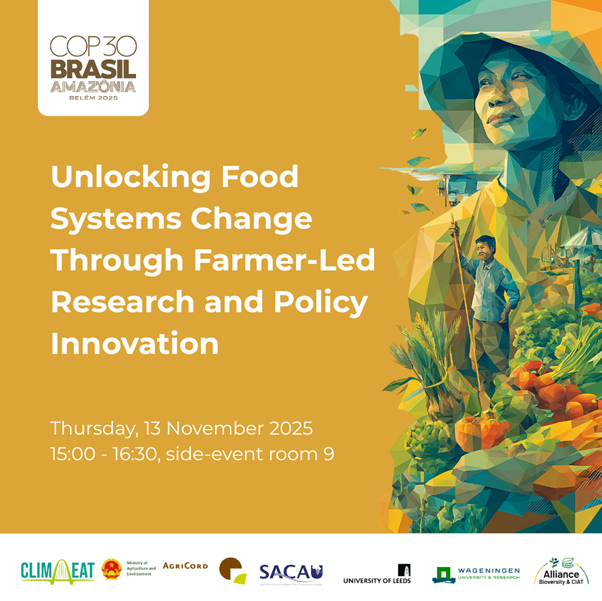
At COP30, the University of Leeds will co-host the side event “Unlocking Food Systems Change through Farmer-Led Research and Policy Innovation” alongside Clim-Eat, Wageningen University, Agricord, and others on Thursday 13 November. The session explores how farmer-led research can reshape institutions and financing to deliver more equitable, climate-resilient food systems.
Professor Piers Forster will highlight how research institutions can better align their work with societal impact, while other speakers - including representatives from farmer unions and development partners - will share lessons from the ground. The discussion will explore how bringing farmers, researchers, policymakers and civil-society actors together can help bridge divides, share learning, and build mutual understanding - showing that transforming food systems depends as much on listening and collaboration as it does on innovation.
Looking ahead
The University of Leeds’ evolving body of food-systems research demonstrates how academic inquiry can inform and accompany real-world transformation. From analysing power dynamics in Tanzanian horticulture to co-creating agroforestry solutions in East Africa, Leeds researchers are helping build the evidence and partnerships needed for truly just transitions.
Through Voices4JRT and related initiatives, the team hopes to amplify farmer-led innovation, strengthen South-South learning, and ensure that policy reform reflects the diverse realities of those living and working in rural areas.
As COP30 reminds us, unlocking food-system change starts with listening - to the farmers, cooperatives, and communities already leading the way – towards a fairer and more sustainable future.